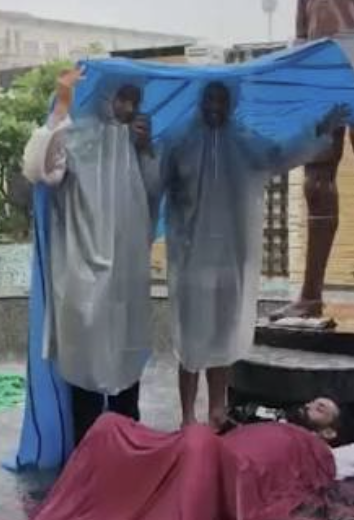
While Delhi's NEET protest faded from the headlines, a new one started in Ranchi — and it's been burning for over a week with far less national attention.
What's happening
Since July 29, students have staged an indefinite sit-in at Jaipal Singh Munda Stadium in Ranchi, protesting alleged irregularities in exams run by the Jharkhand Public Service Commission (JPSC) and Jharkhand Staff Selection Commission (JSSC). Student leader Devendra Nath Mahto — already being called "Jharkhand's Sonam Wangchuk" — has been on an indefinite hunger strike, demanding both a CBI investigation and Chief Minister Hemant Soren's resignation.
This isn't a one-off. Students say it's the latest in a string of paper leaks, cancelled exams, and delayed results stretching back years. Jharkhand's Criminal Investigation Department has already arrested 11 people, including alleged "masterminds" of the latest leak — but protesters say a state-run CID probe isn't enough when the state government itself is implicated, and they want the CBI instead.
Two dates matter for what happens next, and they didn't come from the same place. August 7 — a march to the Jharkhand Assembly — was called specifically by AISA, AISF, and the Jharkhand Janadhikar Mahasabha, who appealed to students to join what they're framing as a continuation of former CM Shibu Soren's own legacy of struggle. August 10 is different: the protesters' own core committee announced that date themselves, independent of any political or student organisation, proposing a Tiranga (tricolor) march followed by a statewide gherao — a mass blockade — of the Assembly, if the government hasn't acted by then.
The CJP no-show
Here's where it gets uncomfortable for the movement that started all this.
Students in Jharkhand have openly said they took confidence from the Cockroach Janta Party's success in Delhi — the NEET protests that ended in the education minister's resignation. But when Jharkhand's students asked CJP's leadership to come stand with them, the answer was silence, then an excuse: CJP founder Abhijeet Dipke said the group was still exhausted from Jantar Mantar and needed a break.
That didn't land well. Students and online critics accused CJP of being happy to lead a national movement but unwilling to show up once the cameras moved to a smaller state capital. Dipke has since said he'll travel to Jharkhand — but by then, some protesting students had already said publicly they didn't want him there anymore.
If CJP's entire credibility rests on being a genuine, leaderless youth movement rather than a personality-driven brand, this is exactly the kind of moment that tests it.
The question about Rahul Gandhi
This is worth asking carefully, not lazily.
BJP spokesperson Sambit Patra publicly questioned Rahul Gandhi's silence on the Jharkhand protests, asking why the Leader of the Opposition — who visited Bihar's BPSC protests in person and was vocal throughout the Delhi NEET agitation — had said little about students facing what looks like the same kind of institutional failure, just in a different state. That's a real, on-record accusation, not a rumor.
It's also fair to note the complication Patra's framing leaves out: Jharkhand's government is a JMM-Congress-RJD coalition. Congress is not an outside critic here — it's part of the administration these students are protesting against. That's a genuine reason a national Congress leader might tread more carefully before piling on his own alliance's state government, and it's a different situation than Bihar or Delhi, where Congress had nothing to lose by showing up.
What we can say with more certainty, and it doesn't reflect well: as the Ranchi protest was actively unfolding, Rahul Gandhi stayed in Delhi, meeting at his residence with students from the Jantar Mantar protest — a protest that had already ended, its main demand already won. He praised their courage and criticised the police response they'd faced weeks earlier, but made no public reference to the students currently on hunger strike in Ranchi. Protesting students there have noticed; one told a television reporter, bluntly, that it was time for him to actually come to Ranchi. Whether that's coalition caution or simply choosing the easier, already-won fight over the harder, ongoing one is a fair question for readers to sit with.
The pattern repeating itself
Paper leaks in Punjab. Paper leaks in Jharkhand. A protest that succeeded in Delhi, then struggled to get the same leaders and the same solidarity to show up somewhere smaller. A national opposition figure who moves fast when the state government isn't his own party's, and more carefully when it is.
None of this makes the students' demands any less legitimate. If anything, it's the opposite — a movement this genuine shouldn't need any political figure's endorsement to matter. The accountability question isn't really about who shows up for a photo. It's about whether JPSC and JSSC exams actually get fixed, in Jharkhand, for students who've been dealing with this for years longer than Delhi's spotlight has existed.
"You're not welcome here if you bring your party agenda"
That's not us paraphrasing — that's a direct line from Pawan Kumar Goswami, a member of the protest's own core committee, describing what the students have been telling every political party that's tried to get close to this movement.
And plenty have tried. An NDA delegation led by Jharkhand's Leader of Opposition, Babulal Marandi, arrived at the protest site in a convoy of cars with security and umbrellas in tow, offering support. Congress and BJP-aligned student wings have shown up. AISA and AISF, the Left-affiliated groups helping organise the August 7 march, are part of the same pattern — everyone wants a foothold on this stage.
Goswami's committee has pushed back on all of it, in both directions: they've said plainly they don't want the protest to become "the stage for a specific political party," any party, and that visiting delegations aren't welcome if they bring their own agenda with them. Unlike the Delhi CJP protests — where Left-affiliated groups (AISA, SFI, AISF, and others) were embedded as organisers from early on — Ranchi's protest has, so far, stayed more centred on the exam issue itself, even as political figures circle it.
Whether that holds as the protest grows past 8 people on hunger strike and toward the bigger August 10 gherao is an open question. But it's worth saying plainly: right now, the pushback against being used is coming from the students, not from us or anyone else deciding it for them.
TYM News is continuing to follow this story, including the planned August 7 march to the Jharkhand Assembly.