Our team was there on the ground at Jantar Mantar. This is everything we saw, everything that's been independently confirmed since, and the accountability questions nobody involved — government, protesters, or the politicians who showed up after — gets to dodge.
What we actually saw
Police in riot gear, lines deep, standing shoulder to shoulder under sodium lights. Protesters — mostly young, mostly there for one reason: NEET-UG. A hand-lettered sign held up into the dark: "You can barricade the road. Not the movement."
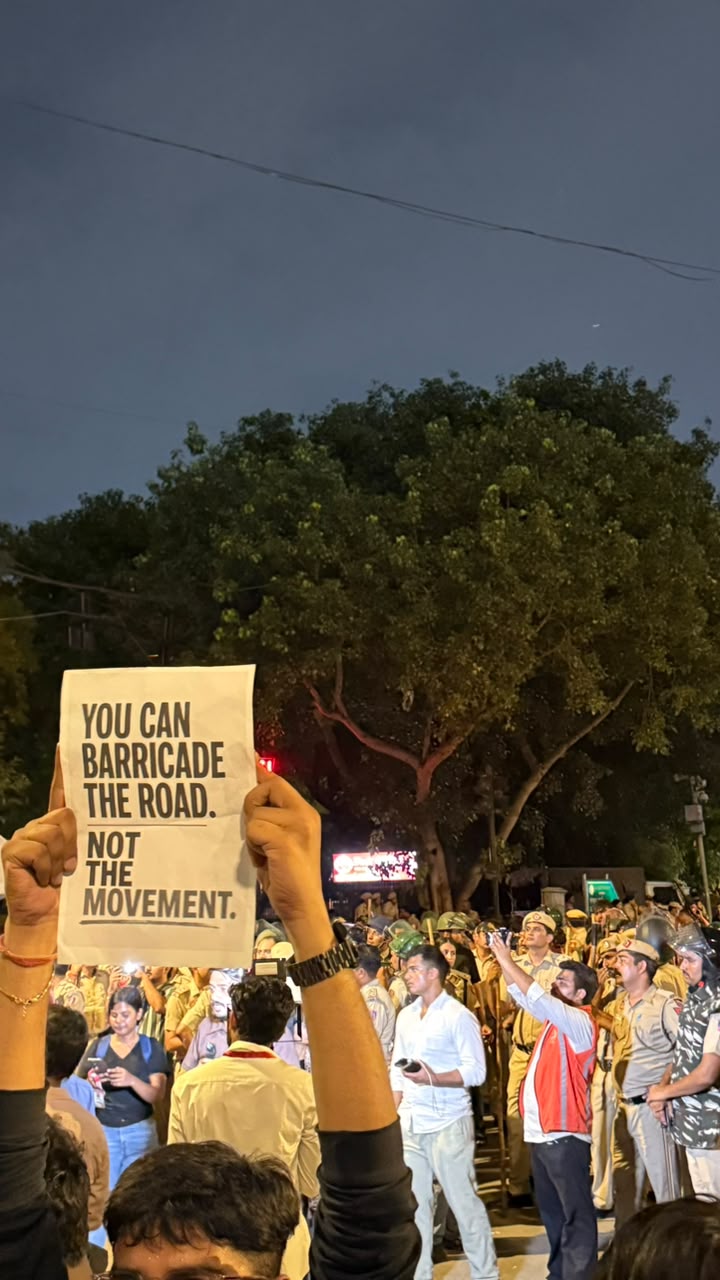
By the time we left, the mood on the street had shifted from chanting to something tighter, more nervous.
Within hours, that tension became a story picked up by international outlets and cited in Delhi High Court filings.
What's been confirmed since
Here's what multiple independent reports, not just protester accounts, agree happened on July 20.
Thousands marched from Mandi House Metro Station toward Jantar Mantar, headed for the Cockroach Janta Party's protest site — part of a larger "Sansad Chalo" mobilization that had been building around Sonam Wangchuk's hunger strike, then in its third week. Delhi Police used lathis to disperse the march. That part isn't in dispute; it's documented by eyewitnesses cited across multiple reports. A Delhi Police ACP was also reported injured amid stone-pelting during the same clashes.
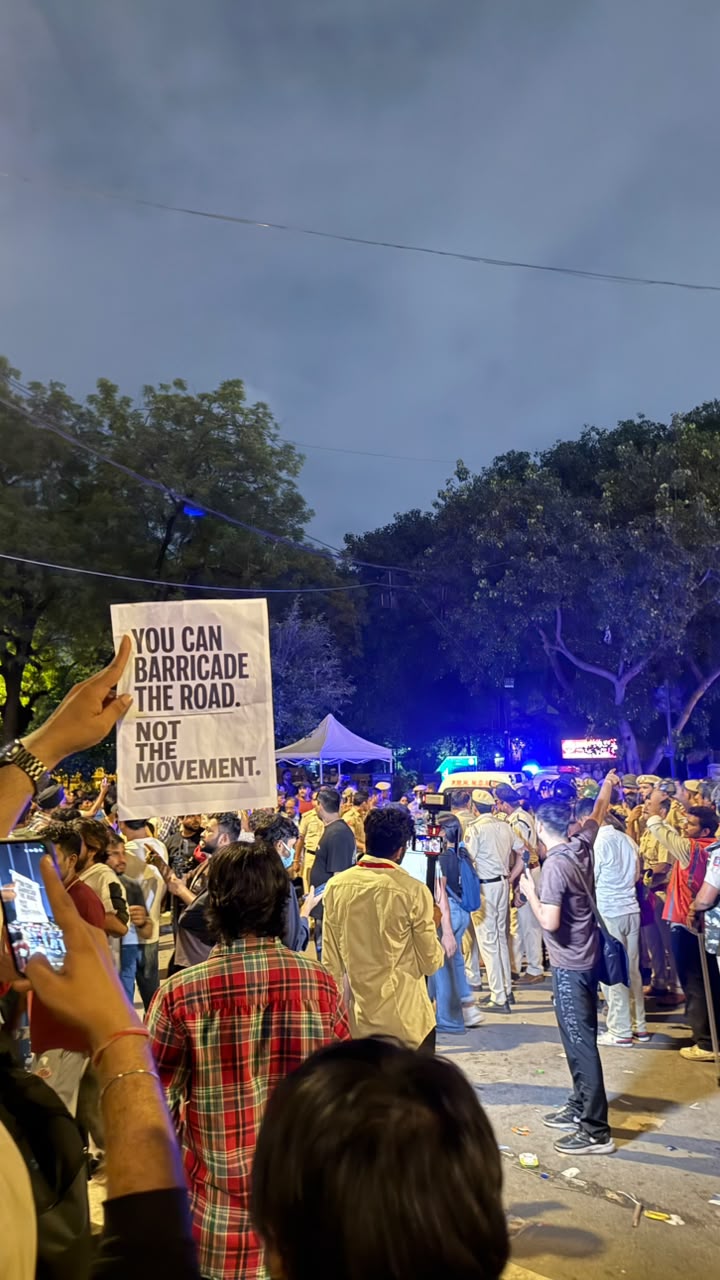
What is disputed: some independent journalists present at the site have said stone-pelting by protesters preceded the police response. If true, that changes the shape of this story considerably — a march that responds to provocation with force is a different story than police charging a peaceful crowd unprompted. Neither claim has been independently and conclusively settled as of this writing, and this piece won't pretend otherwise.
Behind the march itself, the human cost was already mounting. Sonam Wangchuk, on hunger strike for roughly 20 days by that point, had been taken into custody two days before the march even began — and was hospitalized on his 21st day of fasting, later moved to a private hospital under a Delhi High Court order. A public interest litigation has since been filed alleging continuous police surveillance and photography of protesters, calling it an "atmosphere of intimidation."
This isn't one leak. It's a nationwide pattern — and this is just a few examples.
The protest was triggered by the NEET-UG 2026 paper leak — the exam held May 3 was cancelled on May 12 after investigators found a pre-circulated guess paper overlapping with the real one, followed by a CBI probe and arrests. That's on the Centre and the National Testing Agency to answer for, directly.
But paper leaks aren't a NEET problem, or a one-state problem. They've hit recruitment exams, board exams, and entrance tests across the country for years, under governments of every political stripe. What follows are two recent, well-documented examples — not the full list, just enough to show the pattern isn't confined to one party or one exam:
Punjab, AAP-ruled — just three days before the Jantar Mantar lathi-charge, police in Faridkot busted a cheating racket during a pharmacy recruitment exam: 35 detained, hidden pen cameras, wireless earpieces, candidates allegedly paying up to ₹13 lakh for help cheating. Punjab's own Chief Minister has publicly admitted paper leaks recurred in the state in 2017, 2019, 2022, 2024, and now 2026 — while Congress's state unit has separately demanded his and his education minister's resignation over exactly this pattern. AAP has stood visibly close to this protest movement. Its own state's exam record doesn't get a pass because of that.
Jharkhand, JMM-Congress coalition — in April, 164 people were arrested over a leaked excise constable recruitment exam, part of a pattern that included a leaked board exam in 2025 and two separate paper leak incidents in the JSSC recruitment exam in 2024 alone. Even the state's own first chief minister, from the opposition, has publicly tied the pattern to broader complaints about how the state treats protesting youth.
Two different parties. Two different states. Neither the first nor the last such case in India — the same failure keeps repeating nationwide: an exam system nobody in power has actually fixed, everywhere it's been tried.
Accountability — and why "the other side does it too" isn't good enough
If force was used against people who hadn't turned violent at Jantar Mantar, that's a real accountability question for the police response, full stop, regardless of who was in government that day. But it's also fair to note: critics have pointed to the Aam Aadmi Party's own record beyond just paper leaks — the AAP government in Punjab had earlier ordered a lathi-charge on MGNREGA workers, the same tactic, from a party whose leaders have been visible allies of this movement. If police force against protesting citizens is the problem, it's the problem everywhere it happens, not only when the party you dislike is holding the stick.
Everyone wants a piece of this now
This is where the "students' movement" framing gets genuinely complicated — because by the time the dust settled, half the opposition had found a way onto the same stage or the same headline.
Left-aligned student organisations — the Students Federation of India and the All India Students Association among them — haven't just visited this protest; they've been listed as co-organisers alongside CJP since early June, well before this became a national story. That's not incidental support, that's institutional backing from parties with their own long-standing organizing playbook.
Congress leadership went further still. Rahul Gandhi and Priyanka Gandhi Vadra staged a sit-in outside the Prime Minister's residence, were briefly detained by police, and Rahul Gandhi personally called the Prime Minister India's most "anti-youth" leader — rhetoric far beyond simply expressing solidarity. Samajwadi Party chief Akhilesh Yadav was detained alongside them the same day, after separately urging Wangchuk to end his fast. NCP's Sharad Pawar visited the site directly. J&K figures used the same platform to raise the restoration of Article 370 and statehood for the union territory — demands that have nothing to do with an exam system.
None of these parties organized the original protest. All of them have now attached their name, their leaders, or their own separate demands to it — some by standing quietly nearby, others by putting their own senior leadership in front of the cameras at the same site. That's a fair thing to call out regardless of which party is doing it: a movement that started with a specific, answerable demand about a broken exam system is now sharing oxygen with Kashmir's constitutional status, and multiple parties' broader anti-government messaging. Whether that's genuine solidarity or a students' movement being used as a convenient stage is exactly the question this piece won't pretend to have a clean answer to — but it's a question worth asking about every single party doing it, not just the ones you already didn't like.
Where this leaves things
Five things are true at once here, and none of them cancel each other out: a lathi-charge that deserves independent scrutiny regardless of what preceded it; a NEET-UG failure that's still unresolved; a nationwide pattern of paper leaks — Punjab and Jharkhand are just two recent examples among many — that shows this isn't a one-party problem; a growing list of opposition parties — Congress, Left-aligned student groups, and SP among them — who've visibly attached themselves to this movement's stage; and a protest that risks becoming about every politician who's borrowed it, instead of the students who built it.
If you were at Jantar Mantar, or you've seen footage this piece hasn't covered, we want to hear what you saw. This story isn't finished.
TYM News was present at the protest and photographed/filmed the events shown above. We are continuing to verify claims from multiple sides before drawing further conclusions, and will update this piece as the Delhi High Court petition on police conduct proceeds.